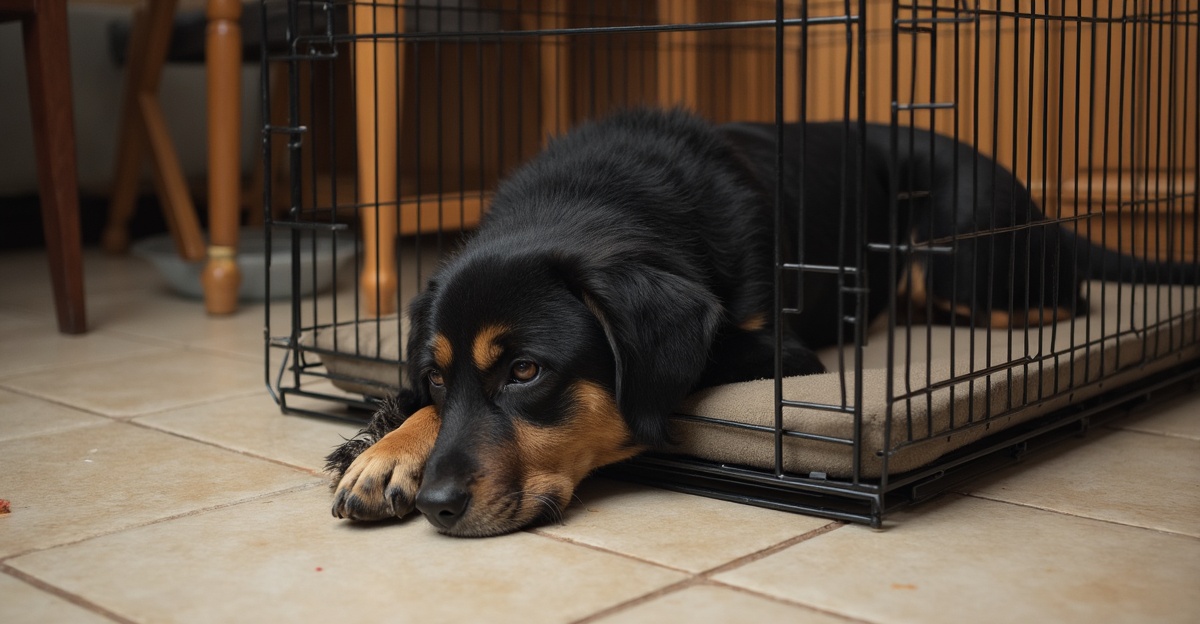
Roughly 20-40% of dogs seen by veterinary behaviorists suffer from separation anxiety. These aren’t misbehaving dogs — they’re panicking. They’ll bend wire crate bars with their teeth, shatter plastic crates, and injure themselves in the process. A standard $50 wire crate becomes a hazard, not a safe space. For dogs with genuine anxiety, you need a crate that’s genuinely indestructible — and ideally, one that helps them feel calm rather than trapped.
Why Standard Crates Fail Anxious Dogs
Wire crates flex under sustained pressure, creating gaps dogs can wedge their jaws or paws into. Plastic crates crack along seams. And most latches are designed to contain, not to resist a panicked 80-pound dog throwing their full weight at the door repeatedly. An anxious dog can destroy a standard crate in minutes, and broken wires and plastic shards cause real injuries — cut gums, broken teeth, and lacerated paws.
Top 5 Crates for Separation Anxiety
1. Impact Collapsible Dog Crate — Best Overall
Built from 20-gauge aluminum with rounded interior corners and a slam latch rated for repeated high-force impacts, the Impact crate is what many veterinary behaviorists recommend first. No exposed welds, no sharp edges, and the ventilation holes are too small for a paw or tooth to catch. It folds flat for travel despite its tank-like durability.
The price is serious ($400-700 depending on size), but owners of anxious dogs know the math: three destroyed wire crates plus one ER vet visit exceeds that cost.
| Pros | Cons |
|---|---|
| Veterinarian recommended | Very expensive ($400-700) |
| Truly escape-proof | Heavy (45-70 lbs) |
| No sharp edges inside | Limited size options |
| Collapses flat for storage | Aluminum dents if dropped |
2. Gunner G1 Intermediate Crate — Most Durable
Originally designed as a crash-tested travel crate, the Gunner G1 is rotomolded from double-wall polyethylene — the same process used to make kayaks. It’s certified to withstand a 4,000-pound load. Anxious dogs simply cannot damage this thing. The escape-proof door uses two-point latches that no dog has figured out yet.
3. ProSelect Empire Dog Cage — Best Heavy-Duty Steel
If your dog has already destroyed an aluminum crate (it happens with the strongest breeds), the ProSelect Empire uses 20-gauge steel with reinforced corners and dual door latches. It’s essentially a bank vault for dogs. At 90+ pounds for the large size, it’s not moving anywhere, which is exactly the point for a dog that tries to push their crate across the room.
4. Diggs Revol Crate — Best for Crate Training
The Revol approaches anxiety differently — through design that makes the crate less prison-like. The ceiling opens fully, the door slides up and stays open, and the puppy divider grows with your dog. While not as indestructible as the Impact or Gunner, the diamond mesh wire and reinforced frame handle moderate anxiety. Best for dogs in the early stages of crate training or with mild separation stress.
5. MidWest iCrate with Bolster Bed — Best Budget Option
For dogs with mild anxiety who haven’t graduated to Houdini-level escapes, the MidWest iCrate paired with a calming bolster bed provides a decent starting point at $50-80. The double-door design, slide-bolt latches, and included divider panel make it a practical first crate. Add a crate cover, a Kong stuffed with peanut butter, and calming music — and many mildly anxious dogs settle in fine.
Comparison Table
| Crate | Best For | Material | Max Dog Size | Price |
|---|---|---|---|---|
| Impact Collapsible | Overall | Aluminum | 100 lbs | $$$$ |
| Gunner G1 | Durability | Rotomolded PE | 95 lbs | $$$$ |
| ProSelect Empire | Heavy-duty steel | Steel | 125 lbs | $$$$ |
| Diggs Revol | Crate training | Diamond mesh | 70 lbs | $$$ |
| MidWest iCrate | Budget/mild anxiety | Wire | 110 lbs | $ |
How to Match Crate Strength to Anxiety Severity
The safest crate is not always the heaviest crate. A dog with mild separation stress may need a predictable den, a cover, and a better departure routine. A dog that bends wire, chips teeth on doors, or bloodies paws needs a different level of containment and a veterinary behavior plan. Before spending $500 or more, put your dog into one of these practical risk levels.
| Anxiety Level | What You Usually See | Crate Type to Consider | What to Avoid |
|---|---|---|---|
| Mild | Whining, pacing, light scratching, settles within 10-20 minutes | Standard wire crate, covered crate, crate with a calm bed | Oversized crates that feel exposed |
| Moderate | Bent wires, repeated escape attempts, heavy drooling, nonstop barking | Reinforced aluminum or high-strength plastic crate | Cheap latches, sharp wire edges, removable trays a dog can grab |
| Severe | Injuries, broken teeth, bloody paws, destroyed doors, panic for the full absence | Veterinary behavior plan first; heavy-duty crate only as management | Crating longer and hoping the dog adapts |
If you are unsure where your dog fits, record a 30-minute video after you leave. The difference between a dog that protests briefly and a dog that panics continuously matters. A crate can prevent property damage, but it should not become a box where panic repeats every day.
Buyer Fit: Which Crate Makes Sense for Your Dog?
Best for dogs that already destroyed wire crates: choose a reinforced aluminum or molded travel-style crate with a secure latch, smooth interior edges, and ventilation holes too small for paws or teeth to catch. The goal is not just strength. The inside surface has to be boring and safe, with no exposed welds, thin bars, or plastic seams your dog can target.
Skip if your dog has never tried to escape: a premium escape-proof crate may be more crate than you need. Start with a correct-size crate, a washable bed, a cover that does not block airflow, and a predictable routine. Spending less at first is reasonable when the risk is mild and there is no history of injury.
Best for large, powerful breeds: pay close attention to crate weight, door hardware, and panel flex. A 70-pound anxious dog can put surprising force into a door. Look for recessed or protected latches and a frame that does not twist when pushed from inside.
Skip if the crate is mainly for airline travel: many heavy-duty anxiety crates are excellent at home but too heavy, too large, or not airline-compliant. If travel is the main use, check the airline’s current crate rules before buying. Do not assume a stronger crate is automatically approved for cargo or cabin use.
Safety Setup Before You Leave the House
Even the strongest crate needs a safe setup. Remove collars, tags, harnesses, and anything that could catch on a latch or ventilation hole. Put the crate on a flat surface where it cannot rock, tip, or slide. If the crate has wheels, lock or remove them. Leave enough space around the sides for airflow, especially with covered crates or thick plastic shells.
For bedding, use caution. A soft bed can help a calm dog settle, but a panicked chewer can shred foam and swallow pieces. If your dog destroys bedding, use a fitted crate mat designed for chewing or leave the floor bare until the anxiety plan is under control. Water bowls should attach securely to the side or stay outside the crate for short absences if your dog flips bowls during panic.
A camera is one of the best upgrades you can add. You do not need an expensive pet camera at first. Any indoor camera that records motion can show whether your dog settles, escalates, or injures themselves. That footage is also useful if you talk with a trainer or veterinarian.
When a Crate Is Not the Main Answer
Separation anxiety is a behavior and welfare problem, not just a containment problem. If your dog is hurting themselves, drooling heavily, trying to chew through metal, or panicking for the entire time you are gone, talk with your veterinarian or a certified separation anxiety trainer. Medication, gradual absence training, and a temporary management plan may be safer than simply buying a stronger crate.
Use the crate as one part of the system: short practice sessions while you are home, calm departures, high-value food puzzles only when safe, and realistic absence lengths. A heavy-duty crate can prevent an emergency, but it should buy you time to fix the anxiety pattern, not replace the training plan.
Crate Safety Is Different From Crate Training
A stronger crate can prevent bending, chewing, and door failures, but it does not teach a dog to feel calm when left alone. For true separation anxiety, the crate is only one part of the plan. The safer approach is to combine a secure enclosure with gradual departures, predictable routines, exercise before alone time, and professional help if the dog panics, drools, injures teeth, or tries to escape through doors or windows.
Fit also matters. A crate should be large enough for the dog to stand, turn, and lie down, but not so oversized that the dog can build speed inside it. Check latch design, weld quality, ventilation, floor comfort, and whether the crate has any sharp edges after assembly. For dogs that chew, avoid soft bedding until you know they will not shred or swallow it.
| Situation | Crate Role | Extra Step |
|---|---|---|
| Mild whining | Comfortable routine space | Short practice departures |
| Chewing bars | Heavy-duty frame and safe latch | Check teeth and reduce alone-time triggers |
| Escape attempts | Containment only if injury risk is controlled | Trainer or vet behavior guidance |
| Severe panic | May not be the right tool | Professional treatment plan |
Frequently Asked Questions
Should I crate a dog with separation anxiety?
It depends on the severity. Some dogs feel safer in a crate — it becomes their den. Others panic more in confinement. Start with a camera to observe your dog’s behavior in the crate when you’re gone. If they settle after 10-15 minutes, the crate is helping. If they panic for the entire duration, consult a veterinary behaviorist before continuing.
What else helps with separation anxiety besides a crate?
Gradual desensitization (leaving for increasing durations), puzzle toys, calming supplements (consult your vet), anxiety wraps like ThunderShirts, and in some cases, prescribed medication. The crate is a management tool, not a cure.
What size crate for a dog with anxiety?
The dog should be able to stand, turn around, and lie stretched out. Too large can actually increase anxiety by removing the “den” feeling. Measure your dog and follow the manufacturer’s size guide closely.
While addressing anxiety, keeping your dog mentally stimulated helps enormously. Check out our picks for aggressive chewers — puzzle toys and durable chews can reduce anxiety-driven destruction. Also, dogs with sensitive stomachs may have worse anxiety, so our sensitive stomach food guide is worth reading.
Pet Product Specialist & Veterinary Nutrition Consultant
Sarah has spent over 8 years reviewing pet products and consulting with veterinarians to help pet owners make informed choices. She shares her home with two rescue dogs, a senior cat, and a very opinionated parrot. Her reviews combine hands-on testing with science-backed research.
Disclosure: This post contains affiliate links. If you purchase through our links, we may earn a small commission at no extra cost to you. Learn more.