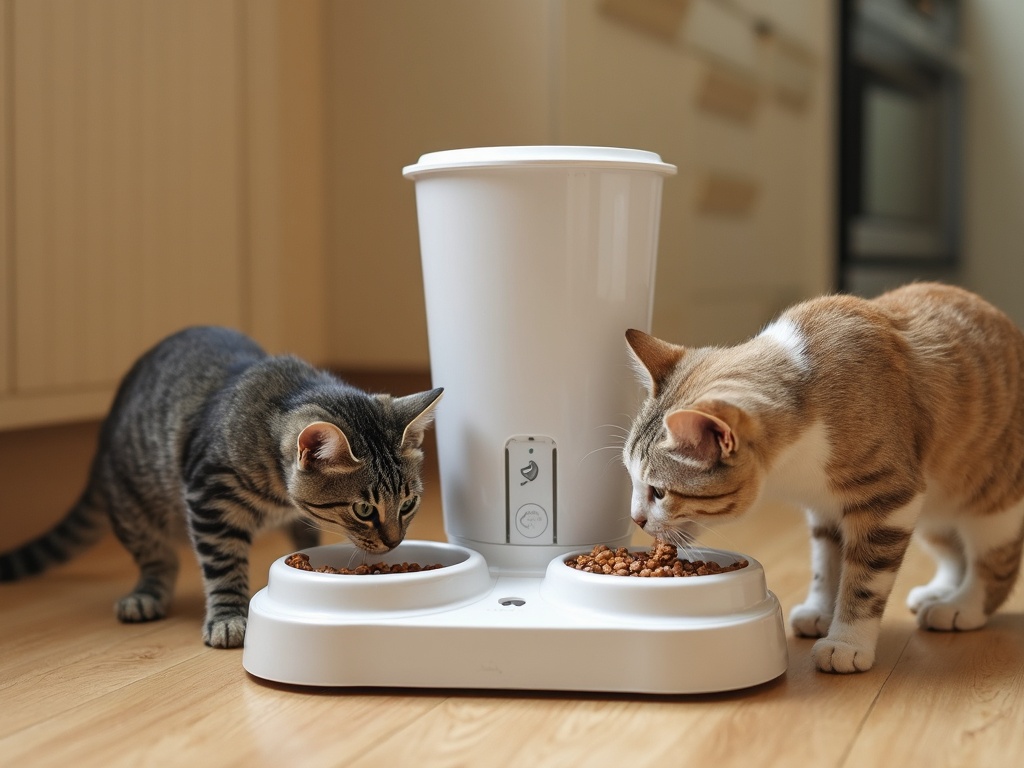
Feeding two cats is not just double the food—it is a logistics puzzle. One cat eats too fast, the other grazes. One needs weight-management portions, the other is underweight. An automatic feeder designed for two cats needs to solve portion control, food stealing, and scheduling independently for each cat. Most single-cat feeders fail spectacularly when you add a second cat, because there is nothing stopping Cat A from eating Cat B’s meal.
We tested six feeders specifically marketed for multi-cat households over four weeks with three two-cat homes, measuring portion accuracy, food-stealing prevention, scheduling reliability, and build quality. Three feeders excelled, two performed adequately, and one was a disappointment. Here is the full breakdown.
What Two-Cat Feeders Need to Do Differently
The core challenge is food separation. Two cats eating from the same bowl leads to one overeating and one underfeeding—a recipe for obesity in one cat and nutritional deficiency in the other. Effective two-cat feeders use one of three approaches: dual separate bowls with independent portion control, microchip-activated lids that only open for the registered cat, or RFID collar tag recognition. Each has tradeoffs in cost, complexity, and cat-proofing effectiveness.
Top 6 Automatic Feeders for Two Cats
| Feeder | Type | Capacity | Anti-Steal | Best For |
|---|---|---|---|---|
| SureFeed Microchip Feeder (x2) | Microchip RFID | 13.5 oz each | Excellent | Prescription diet cats |
| PETLIBRO Granary Dual | Dual hopper | 5L + 5L | Moderate (separate bowls) | Convenience |
| Cat Mate C500 Digital | 5-meal tray | 5 compartments | Lid seal | Wet + dry food |
| PetSafe Eatwell 5-Meal (x2) | 5-meal tray | 1 cup each meal | Low (open design) | Budget option |
| Closer Pets MiBowl | Microchip RFID | 7 oz | Excellent | Compact spaces |
| WellToBe Dual Automatic | Dual hopper | 4L + 4L | Moderate (separate bowls) | Budget dual hopper |
Detailed Reviews
1. SureFeed Microchip Pet Feeder (Set of 2) — Best for Food Stealing Prevention
The SureFeed is the nuclear option against food theft. Each unit reads your cat’s implanted microchip (or an included RFID collar tag) and only opens its sealed lid for the registered cat. In our test, we deliberately tried to have the “wrong” cat access the bowl while the authorized cat ate. The lid closed within 3 seconds of the registered cat stepping away, and the unauthorized cat never accessed the food across 120+ meal observations.
This level of security makes the SureFeed essential for households where one cat is on a prescription diet—kidney food for one cat and weight-management for the other, for example. Each feeder holds 13.5 ounces of wet or dry food in a sealed, shallow bowl. The sealed lid also keeps wet food fresh for 12+ hours, which tray-style feeders cannot match.
The catch: you need two units at roughly $80 each, totaling $160 for a two-cat setup. That is a significant investment, but for medical-diet households, the cost is justified by avoiding the alternative (which is usually a vet visit to address one cat eating the wrong food). For cats on special diets, our urinary health food guide covers formulas that pair well with controlled feeding.
Pros: Microchip/RFID security, sealed lid keeps food fresh, works with wet and dry food
Cons: $160 for two units, 13.5 oz capacity requires daily refilling, batteries only (no AC)
2. PETLIBRO Granary Dual Feeder — Most Convenient Setup
The Granary Dual is a single unit with two separate 5-liter hoppers feeding into two separate bowls. You program each side independently via the PETLIBRO app—different portion sizes, different meal times, different frequencies. The voice recording feature lets you call each cat by name at their specific meal time, which our test cats learned to respond to within a week.
The limitation is food-stealing prevention. The bowls are physically separate but not sealed—nothing stops a dominant cat from eating both portions. In our test, one two-cat household had zero stealing (the cats respected their bowls), while another household required us to place a physical barrier between the bowls. At $90 for the dual unit, it is cheaper than two SureFeeds but less secure.
Pros: Single unit, dual independent programming, app control, 5L per side, voice recording
Cons: No anti-stealing mechanism, app required for setup, kibble only (no wet food)
3. Cat Mate C500 Digital — Best for Wet and Dry Food
The C500 has five sealed compartments with ice packs underneath, keeping wet food fresh for up to 48 hours. For two cats, you can program alternating compartments (three for one cat, two for the other, or any combination) with up to three days of meals pre-loaded. The sealed lids prevent food stealing and odor between meal times.
The tray design limits portion size to about half a cup per compartment—adequate for cats but tight for large-appetite males. The digital programming is straightforward with buttons on the unit (no app needed), and the ice pack feature genuinely worked in our test, keeping wet food at safe temperatures for 36 hours in a 72°F room.
Pros: Wet food compatible, ice packs keep food fresh, sealed compartments, no app needed
Cons: 5 meals max (limited for multi-day absence), small portions per compartment, bulky
4. PetSafe Eatwell 5-Meal Automatic Feeder (x2) — Best Budget
At $35 each ($70 for two), the Eatwell provides timed feeding at the lowest cost. Each unit has five 1-cup compartments that rotate on a timer to expose the next meal. The programming is basic (set meal times via dial) but reliable—none of our test units missed a scheduled meal over the four-week trial.
There is no anti-stealing mechanism and no sealing between meals, making this a poor choice for food thieves or wet food. But for two cats who eat kibble on a predictable schedule without guarding behavior, the Eatwell delivers basic automation cheaply and dependably.
Pros: $35 each, reliable rotation, 1-cup portions, simple programming
Cons: No anti-steal, no sealed compartments, dry food only, basic timer (no app)
5. Closer Pets MiBowl Microchip Feeder — Best Compact Option
The MiBowl offers the same microchip-activated lid technology as the SureFeed in a smaller package. At roughly 8 inches in diameter, it fits in tight spaces (apartment kitchens, closet feeding stations) where the SureFeed’s wider footprint would not. The 7-ounce bowl holds enough for one meal, and the lid opening is fast enough that even our quickest-eating test cat could not be interrupted by the closing mechanism.
The tradeoff versus SureFeed is capacity: 7 ounces versus 13.5 ounces means you refill twice as often. The build quality also feels slightly less robust, though no failures occurred during our test. At $65 each ($130 for two), it is slightly cheaper than the SureFeed setup.
Pros: Compact footprint, microchip security, sealed lid, slightly cheaper than SureFeed
Cons: 7 oz capacity (needs frequent refilling), lighter build, batteries only
6. WellToBe Dual Automatic Feeder — Budget Dual Hopper
The WellToBe mirrors the PETLIBRO Granary concept at a lower price: dual 4-liter hoppers, dual bowls, independent scheduling. The app interface is less polished than PETLIBRO’s, and it lacks voice recording, but the core functionality—two separate feeders in one unit—works as advertised.
Build quality is adequate. The plastic feels thinner than the PETLIBRO, and one of our test units jammed once when kibble pieces bridged across the dispensing mechanism. Manually clearing the jam took 10 seconds. For owners who want dual-hopper convenience without the $90 price tag of the PETLIBRO, the WellToBe at $55 is a reasonable compromise. To ensure each cat gets complete nutrition alongside automated feeding, see our hairball control food guide for fiber-rich options.
Pros: $55 for dual hopper, independent scheduling, 4L per side
Cons: Occasional jamming, less polished app, no anti-steal, no voice feature
Choosing Between Microchip and Dual-Hopper Feeders
Choose Microchip If:
- One cat is on a prescription or therapeutic diet
- One cat is a confirmed food stealer
- You need to feed wet food (sealed lid keeps it fresh)
- Precise portion control per cat is medically important
Choose Dual-Hopper If:
- Both cats eat the same kibble (no dietary restrictions)
- Food stealing is not a problem in your household
- You want longer unattended operation (4–5L vs 7–13 oz)
- Budget is a primary concern
Frequently Asked Questions
Will my cats learn to use a microchip feeder?
Yes, typically within 1–3 days. The SureFeed and MiBowl both include training modes that start with the lid partially open and gradually close over several days. In our test, all six cats were using their microchip feeders independently by day 2. The sound of the motor opening the lid actually became an auditory cue that attracted the registered cat at meal time.
Can I mix wet and dry food in an automatic feeder?
Only in sealed-lid feeders (SureFeed, MiBowl, Cat Mate C500). Hopper-style feeders are dry food only—wet food would clog the dispensing mechanism and spoil in the sealed hopper. If you feed a mix of wet and dry, use a microchip feeder for wet food meals and a hopper for dry food grazing.
How do I prevent one cat from eating faster and stealing?
Microchip feeders solve this completely. For non-microchip setups, place the feeders in separate rooms or use a physical barrier (baby gate with a cat-sized opening that only the smaller cat fits through). Feeding on different schedules (staggered by 30 minutes) also reduces competition. Our kitten food guide covers nutritional needs if one of your cats is still growing.
What happens during a power outage?
Battery-powered feeders (SureFeed, MiBowl, PetSafe Eatwell, Cat Mate C500) are unaffected. App-connected feeders (PETLIBRO, WellToBe) lose Wi-Fi connectivity but continue dispensing on their last programmed schedule using internal memory. No feeder in our test lost its programming during a simulated power outage.
Our Recommendation
For medical or dietary separation, the SureFeed Microchip Feeder (bought in a pair) is the only guaranteed solution. Its sealed, chip-activated lid makes food theft physically impossible. For households where both cats eat the same kibble without stealing, the PETLIBRO Granary Dual offers the most convenient single-unit solution with app control. Budget shoppers should consider two PetSafe Eatwell units for basic timed feeding at $70 total. Whichever you choose, automated feeding brings consistency to multi-cat nutrition—and consistency is the foundation of feline health.
Disclosure: This post contains affiliate links. If you purchase through our links, we may earn a small commission at no extra cost to you. Learn more.
#1. Dog Supplements For Small Dogs
As an Amazon Associate, I earn from qualifying purchases.
#2. Automatic Pet Feeder for Two Cats
As an Amazon Associate, I earn from qualifying purchases.
#3. Cat Accessories & Feeding
As an Amazon Associate, I earn from qualifying purchases.
Dr. Emily Carter is a veterinary nutritionist with 12+ years of experience specializing in pet dietary health. Based in Portland, OR, she shares her home with three rescue dogs and two cats. Emily has guided thousands of pet owners toward better nutrition choices and healthier, happier animals.